Alan Pollack
Staff artist
Adapted from the fact-checked Tabletop Game Icons profile and human-reviewed for Legends of TSR.
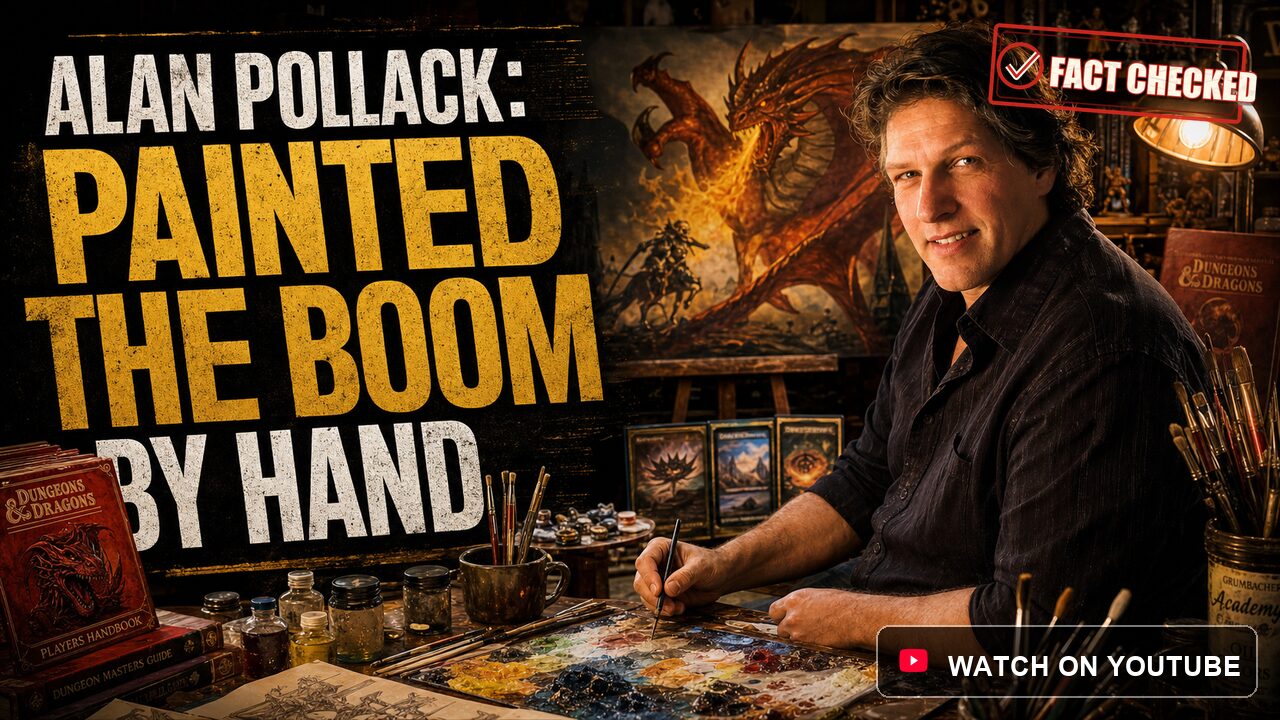
Alan Pollack came into tabletop gaming at the moment when fantasy art was being asked to do two jobs at once.
It had to sell the book from across the store.
Then it had to survive the table, the way a rulebook survives: by being handled, argued over, remembered, and reimagined.
A dragon could not just look dramatic on a cover. It had to feel heavy enough that a player believed the thing had bones, muscles, heat, and shadow. A wizard could not just point at a glowing spell. The light had to hit the face, the sleeve, the wall behind him. The imaginary world had to look as if someone could step into it and get dirt on their boots.
That was the work Pollack did: not just making fantasy look cool, but making it look physically trustworthy.
He was not one of the first wild draftsmen of the 1970s hobby. He arrived later, after fantasy gaming had grown up enough to need polish, speed, and professional visual authority. His career runs through TSR, Dragon and Dungeon magazines, Dungeons & Dragons, Magic: The Gathering, Middle-earth card art, book covers, and modern artist proofs.
The thread is not a single monster, setting, or game system.
The thread is paint.
The Tsr Room
Pollack was born in New Jersey in 1964. His official bio says he was influenced early by artists such as Frank Frazetta and Boris Vallejo, then studied in New York at the School of Visual Arts, Parsons School of Design, and the New School of Figurative Art.
Before tabletop gaming became his professional home, he worked part time as a silk screener and photo retoucher while building a portfolio. He has talked about drawing monsters, dinosaurs, album covers, and rock-band imagery when he was young. That detail matters. Before he was painting spellfire for gamers, he was already trying to make pop mythology look physical.
His first cover assignment for TSR came in 1991, for Dungeon Magazine. Soon after, he was offered a staff position at TSR.
That placed him inside one of the last great in-house art rooms in tabletop gaming.
The 1990s TSR art department was not the remote freelance economy that defines much of the industry now. Pollack has described working in a closed room with other artists, painting while music played, learning from people who had been doing the job longer than he had. In a later Sorcery interview, he named Jeff Easley, Tony Szczudlo, Fred Fields, Brom, Robh Ruppel, Dana Knutson, and Jennell Jaquays among the people connected to that period of his life.
He also said he learned glazing techniques from Easley.
That is the kind of sentence that explains more than a resume can. A company can hire an artist. A room can shape one. It can teach you speed, taste, and the quiet craft decisions that keep an image from collapsing.
Dragon, Dungeon, And The Shared World
Pollack's TSR years put his art in front of the roleplaying audience at a time when magazines still carried the hobby's nervous system.
Before social media, before searchable image feeds, before every publisher had a constant online preview cycle, Dragon and Dungeon were monthly portals. Players learned rules there. They saw new monsters there. They stared at covers and interior art there long before a product ever reached their table.
Pollack worked in that space.
His art appeared across Dungeons & Dragons products and periodicals during the mid-1990s, a period when TSR needed a great deal of visual material fast. Second Edition was expanding through campaign worlds, boxed sets, splatbooks, adventures, monsters, strange planes, and one-off experiments. Every product needed a face.
That work required more than imagination. It required discipline.
A fantasy painter for D&D has to make impossible things behave as if they are subject to physical law. Armor has to hang on the body. Stone has to feel cold. Leather has to crease. A dragon wing has to catch light in a way that tells the eye where the bone is. If the image fails at that level, the viewer may not know why, but the spell breaks.
Pollack's strength was making the image hold.
He did not make the strange look casual. He made it look built.
The Oil-Paint Problem
The supplied research for this piece leans hard on Pollack's traditional oil-paint method, and it is the right place to look. Oil paint changes the emotional weight of fantasy art.
Oil is slow. It is messy. It resists corporate speed.
It also gives the image depth.
Pollack later clarified in a Baen interview that his process became mixed. When he works traditionally, he uses oils, often with an acrylic underpainting. He has also worked digitally, using Corel Painter and Photoshop. That distinction matters. He is not frozen in one medium.
Still, the oil-paint instinct is central to why his work feels the way it does.
Oil lets a painter build light through layers. A glaze can sit over an underpainting and let light travel through color before it comes back to the eye. Shadows can be blended until they feel like air instead of ink. A bright red, one of the colors Pollack has talked about using for attention, can become a wound, a torch, a sunset, or a book-cover alarm bell.
In tabletop gaming, that matters because the art is often doing the emotional work before the rules begin.
The rules tell you what the sword does.
The painting tells you why anyone would pick it up.
The Card Era
Then the industry changed under everybody's feet.
TSR's old model was expensive. Wizards of the Coast had changed the business with Magic: The Gathering. Card games needed huge amounts of art, delivered quickly, printed small, and repeated across expansions. The staff-room model gave way to a wider freelance economy.
Pollack moved with it.
After TSR, he freelanced for Wizards of the Coast and other publishers. His official bio names clients including Wizards, Erik's Curiosa, Blizzard Entertainment, HarperCollins, DAW Books, Del Rey, Baen Books, Tor Books, ROC, and the Science Fiction Book Club. The Baen interview describes him as having illustrated Magic cards and other gaming pieces after TSR. His official artist-proof page now sells proofs for Magic: The Gathering, Warcraft, and Sorcery: Contested Realm.
Card art is a different kind of test.
A book cover can use the whole rectangle. A magazine cover can pull you in with atmosphere. A trading card has almost no room. The illustration must work inside a small window, under rules text, inside a border, while sitting in a player's hand or on a table.
That changes the painting.
The silhouette has to read fast. Values have to survive reduction. The focal point has to be cruelly clear. A beautiful piece that depends on subtle background storytelling may die at card size. A strong card image has to land in one glance and still reward a second look.
Pollack's work in that field shows the shift from fantasy illustration as a single large image to fantasy illustration as a repeated, modular part of a game system.
Middle-Earth In A Small Box
One of the clearest examples is the Middle-earth Collectible Card Game from Iron Crown Enterprises.
Released in 1995, MECCG was one of the first major attempts to turn Tolkien's world into a collectible card game. Tolkien Gateway lists Pollack among the many illustrators whose work appeared in it, alongside artists such as John Howe, Ted Nasmith, Angus McBride, Liz Danforth, Donato Giancola, and others. A Finarte auction listing also identifies Pollack's preliminary drawing for the 1997 MECCG card Join With That Power.
That project asked for a different tone than a lot of D&D art.
Middle-earth is not just spectacle. It carries age, loss, weather, stone, iron, and old roads. The best Tolkien art does not only show you a monster. It makes you feel how long the world has been carrying the monster.
Pollack's painterly strengths fit that demand. Texture. Shadow. Atmosphere. Figures that feel placed in old air.
He was one artist among many on the project, not the sole visual architect of MECCG. That boundary matters, because the real story here is range, not ownership. But his presence there shows where his career sat: between the RPG book era and the card-art boom, between staff rooms and freelance packets, between oil paint and mass-market cardboard.
Book Covers And The Shelf
Pollack's career did not stay inside tabletop.
Baen's 2014 interview places him firmly in the science-fiction and fantasy book-cover world. He painted covers for Larry Correia's Monster Hunter International books and Grimnoir Chronicles, along with work connected to authors such as David Drake, Sarah A. Hoyt, Sharon Lee and Steve Miller, James Hogan, and others.
Book covers sharpened a skill he already had from gaming: make the image jump.
Pollack told Baen that his goal was to get a viewer to stop and look at the cover. He talked about exciting compositions, lighting, color, and dynamic camera angles. He also said he often tries to find a scene from the book, or create a scene that feels as if it could have been in the director's cut.
That is a tabletop instinct too.
The picture is not just a decoration. It is a playable invitation. It says: here is the moment. Here is the danger. Here is the room. Step in.
What He Actually Built
Alan Pollack did not invent fantasy gaming art. He did not create the TSR visual identity alone. He was not the only painter who carried classical technique into the tabletop boom.
What he built was a bridge.
He carried hand-painted weight through a period when the industry was changing shape. At TSR, he worked inside the last version of the old in-house fantasy art room. In D&D and Dragon-era work, he helped give late Second Edition fantasy its physical atmosphere. In card games, he adapted that painterly language to a tiny, commercial format that had to read instantly. In book covers, he pushed the same sense of action, color, and shelf impact into another market.
His career shows what happened to the fantasy illustrator in the 1990s.
The room disappeared.
The painting had to travel. And the artist had to carry the standards of that room alone, into emails, deadlines, art-direction notes, and a marketplace where the work is judged at thumbnail size.
Pollack made it travel without losing the hand.
Where To Find Him
Alan Pollack remains publicly active through his official website, alanpollack.com, which includes his bio, galleries, artist proofs, contact page, and social links. His official artist-proof page lists Magic: The Gathering, Sorcery: Contested Realm, and Warcraft CCG proofs, with options for signatures, sketches, and painted proofs.
The Encyclopedia of Science Fiction updated its Pollack entry in June 2025 and lists him as a living illustrator born in 1964. His official bio notes his 2015 Hugo Award nomination for Best Professional Artist and recent or continuing connections to clients including Wizards of the Coast, Erik's Curiosa, Blizzard Entertainment, and major book publishers.
He is still reachable. The gallery is up. The proof page is still selling small pieces of card history that collectors can literally hold in their hands.
That feels right for Pollack.
The old tabletop boom was built from paper, ink, cardboard, and paint. Some of it became rules. Some of it became memory. In Pollack's case, a lot of it still looks wet enough to catch the light.