 In Memoriam
Brian Blume
Executive, co-owner, designer
TSR 1974-1985
Adapted from the fact-checked Tabletop Game Icons profile and human-reviewed for Legends of TSR.
Brian Blume's role in Dungeons & Dragons history is uncomfortable because it refuses to stay in one moral category.
He was not Gary Gygax. He was not Dave Arneson. He did not make the conceptual leap that turned wargaming into roleplaying, and he did not become the public authorial voice of the early game.
But in 1973, he put in the money that helped make Dungeons & Dragons a printed product instead of a manuscript waiting for someone else to risk cash on it.
Then, a decade later, Blume's stock power and executive decisions helped end Gary Gygax's control of TSR.
That is the whole problem in miniature. Brian Blume was both enabling force and destabilizing force. Capital made the door open. Control helped slam it shut on the founder era.
The Tool-And-Die Mind
Blume was born in Oak Park, Illinois, in 1950 and grew up in Wauconda. His background was not bohemian fantasy literature or academic medievalism. It was practical, industrial, and precise.
His father owned a tool-and-die business. Blume left Wabash College and trained as a journeyman tool-and-die maker, learning a craft built around tolerances, repeatable parts, and the physical logic of production.
That background matters.
Early Dungeons & Dragons needed imagination, but it also needed manufacturing. It needed paper, printing, boxes, cash, distribution, invoices, and people willing to turn a strange set of fantasy rules into objects customers could buy. Gygax and Arneson created the essential play breakthrough. Blume helped provide the capital and business frame that let the first commercial version exist.
He was also a gamer. He played chess as a child, discovered historical games early, and became part of the miniature wargaming culture that surrounded Gygax in the Midwest. That made him more than a banker looking at a hobby fad. He understood games well enough to care, and he had enough practical business footing to act.
The Two Thousand Dollars
Tactical Studies Rules began small enough that the numbers still feel human.
Gary Gygax and Don Kaye had formed the original partnership, but they did not have enough money to print Dungeons & Dragons as a proper boxed set. Blume came in with a $2,000 investment and became an equal partner.
That money mattered.
The first printing of Dungeons & Dragons was only 1,000 copies. By modern standards, that is tiny. By 1974 standards, for a weird fantasy game emerging out of wargaming culture, it was a leap. Someone had to pay for paper before anyone knew whether the market existed.
Blume took that risk.
The game sold. Then it sold again. The small partnership suddenly had something real on its hands, something stranger and more powerful than any of them fully understood.
Don Kaye's death in 1975 forced the next transformation. His widow inherited his share, and Gygax and Blume needed a way to keep the company moving. TSR reorganized as a corporation, TSR Hobbies, with help from Blume family money. Brian's father, Melvin Blume, invested to buy out Donna Kaye's interest.
That solved one problem and created another.
The new corporate structure gave the Blume family significant power. Gygax remained the creative face of the company, but he was no longer simply the master of his own table. D&D had entered corporate reality.
The Other Creator In The Room
Brian Blume was not just a checkbook.
His creative fingerprints run through early TSR. He co-authored Warriors of Mars, helped create Boot Hill, wrote Panzer Warfare, and co-authored Eldritch Wizardry with Gygax. Eldritch Wizardry introduced psionics, one of early D&D's strangest and most controversial systems, and brought in artifacts and darker pulp-fantasy ideas that would echo for decades.
Blume is also connected to Vecna, one of D&D's most enduring villainous figures. The Hand and Eye of Vecna gave the game a kind of grotesque mythic horror that stood apart from clean heroic fantasy. He helped add weirdness to the early game, not just money.
Then there is Rary.
In Gygax's Greyhawk campaign, Blume created a magic-user named Rary mostly for the joke. A first-level magic-user was called a Medium. Blume reportedly played the character only long enough to become third level, so he could say "Medium Rary."
It is a perfect early-D&D detail: half rules joke, half table joke, somehow immortalized in official spells.
Later TSR would turn Rary into a traitor in Greyhawk continuity. Fans have often read that as meta-commentary on Blume's real-world role in the company struggle. Whether that was the intent or not, the resonance is obvious. The joke character became a symbol of betrayal.
That is how Blume's memory works in the hobby. Even his funny stories carry knives.
The Outward Deal
One of Blume's most important positive contributions was international.
In 1975, he received a copy of Owl and Weasel from the young British company Games Workshop. Instead of ignoring it, he responded by sending Dungeons & Dragons to Ian Livingstone and Steve Jackson. That exchange helped lead to Games Workshop becoming an early distributor for D&D in the United Kingdom.
This was not a minor footnote.
D&D's spread depended on enthusiasts, retailers, convention tables, zines, and small channels of distribution that could make the game visible far from Lake Geneva. Blume saw the opportunity and opened the relationship. Games Workshop would become one of the major forces in British hobby gaming, and D&D's early UK presence mattered to the growth of the international RPG audience.
It is another example of the better Blume pattern: practical action at the exact moment when the game needed a bridge.
The Empire Gets Heavy
By the early 1980s, TSR was no longer a tiny partnership.
It had employees, departments, buildings, product lines, fiction, licensed properties, distribution problems, and a public profile. Brian and Kevin Blume held major power in the company while Gygax spent long stretches focused on Hollywood and entertainment licensing.
This is where the old fan story often flattens. The Blumes made serious mistakes. But Gygax was not simply at home doing perfect stewardship while villains wrecked his company. He was often absent, and his Hollywood efforts consumed time, money, and attention.
The company grew too fast and diversified too strangely.
TSR pursued products far outside its core business, most famously Greenfield Needlewomen, a needlecraft company that became shorthand for how lost the strategy had become. It took on high overhead. It carried more staff and more management weight than the market could comfortably support. The company bought SPI's assets after a loan arrangement collapsed, but refused to honor SPI's lifetime magazine subscriptions, damaging TSR's standing among old-line wargamers.
There were successes too. The period saw the broader D&D boom, fiction expansion, new games, and mass-market visibility. But TSR's internal structure was getting heavier.
By 1983 and 1984, the company was in financial crisis.
The Sale That Ended The Founder Era
Gygax returned from Hollywood to a company in trouble and moved to regain control. Kevin Blume was pushed out of executive power, but Brian and Kevin still held stock and board leverage.
Gygax brought in Lorraine Williams as an administrative ally. That choice turned against him.
In 1985, Brian Blume exercised a stock option and the Blume brothers sold their controlling interest to Williams. Gygax challenged the sale and lost. The legal documents held. The company moved under Williams' control, and Gygax soon left TSR.
For many fans, that moment defined Brian Blume forever.
The man whose $2,000 helped open the first door had now helped sell the building out from under the public face of Dungeons & Dragons. It is not hard to understand why the story became bitter. Corporate law and emotional ownership were not the same thing. Gygax felt betrayed. Many players agreed.
But history is rarely kind enough to give us clean characters.
Blume had helped build the company. He had the right to sell his shares. He had also participated in the chain of decisions that made TSR unstable enough for the sale to happen. The transaction was legal. It was also culturally devastating.
Both facts remain.
The Cartographer After The Empire
After TSR, Blume largely disappeared from public gaming life.
He did not spend decades defending himself in interviews. He did not become a convention personality. He did not write the great counter-memoir of early TSR.
Instead, he eventually returned to a quieter kind of craft. In the 1990s, he did freelance cartography for White Wolf, contributing maps to World of Darkness books. The shift is striking: the former TSR power broker working as a mapmaker for the next generation of RPG publishers.
There is something almost literary about it.
The tool-and-die mind returned to lines, grids, rooms, streets, and systems. Not the whole corporation. Just the map.
Blume's later life moved mostly outside the public hobby conversation. According to his obituary, he worked as a computer technician and volunteered for years at the Lake Geneva Public Library. He lived with Lewy Body Dementia and Parkinson's disease before his death on March 27, 2020, in Elkhorn, Wisconsin. He was seventy.
What He Actually Built
Brian Blume did not invent roleplaying.
He did not give Dungeons & Dragons its central creative voice. He did not become the public face of the hobby. He did not manage TSR without serious mistakes.
What he built was the first business structure strong enough to carry D&D beyond the founders' immediate reach.
That structure was imperfect from the beginning. It gave the Blume family too much leverage over Gygax. It helped turn creative partnership into corporate struggle. It produced growth, but also overhead, diversification errors, and resentment. It made D&D more real as a business and more vulnerable as a company.
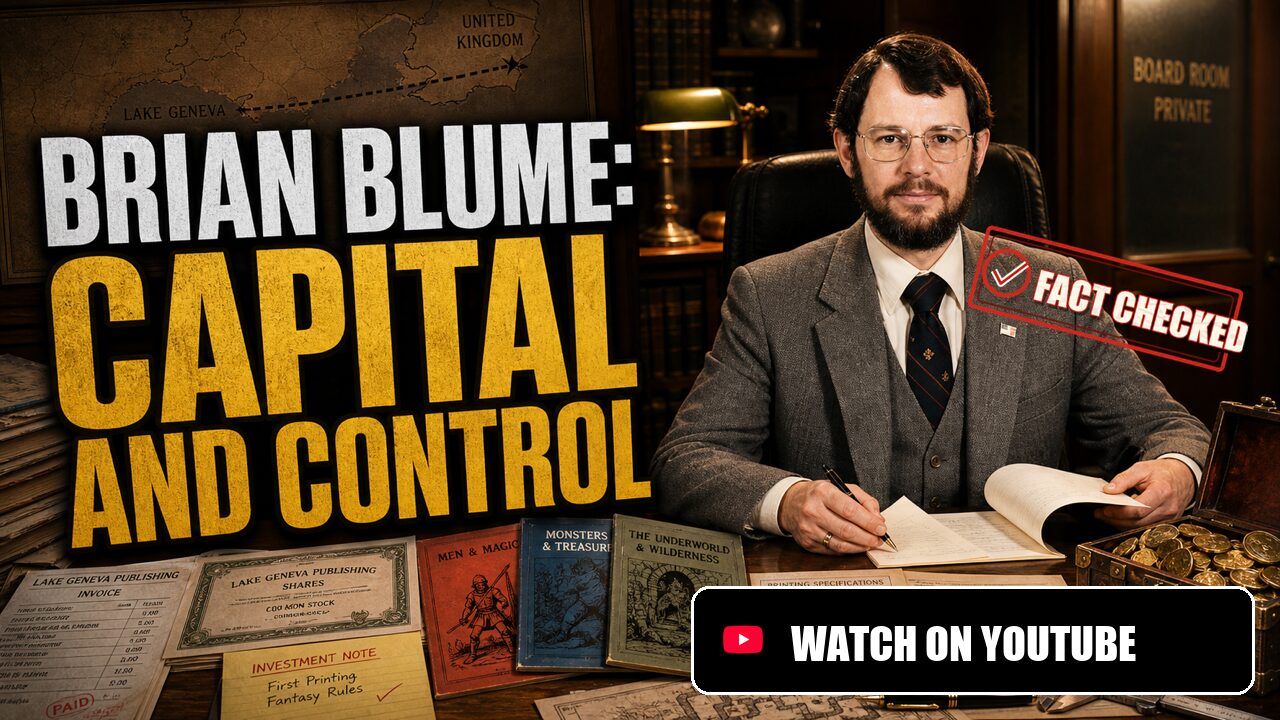
Blume's legacy is capital and control.
The capital was necessary. Without money for the first printing, D&D might still have emerged somehow, but not in the same way, at the same time, through the same small company. The control was dangerous. Once D&D became stock, shares, options, and board votes, the game belonged not only to the people who imagined it but to the people who owned pieces of the company.
That is not a simple villain story. It is the moment the hobby became an industry.
Where To Find His Legacy
Brian Blume's legacy is in every copy of Dungeons & Dragons that exists because the first printing happened.
It is in Vecna, psionics, Boot Hill, Rary, early TSR distribution, and the Games Workshop bridge. It is also in the cautionary story of TSR's first corporate war: how quickly friendship, creativity, capital, and control can become incompatible once a game becomes a company.
He helped make D&D possible as a product.
He also helped make TSR impossible as a founder-led dream.
That is why Brian Blume remains hard to remember cleanly. He was not the hero of the story. He was not only the traitor of the story. He was the financier at the beginning, the shareholder at the crisis, and the quiet mapmaker after the empire moved on.
The door opened because someone paid to print the game.
The cost of that door came later.