Dale Donovan
Editor and designer
Adapted from the fact-checked Tabletop Game Icons profile and human-reviewed for Legends of TSR.
Dale Donovan is the kind of tabletop designer history has trouble remembering cleanly.
He was not the face of a flagship setting. He did not become a celebrity auteur. He did not have one famous personal system that fans can point to and say: there, that is the Donovan game.
Instead, his name keeps appearing in the places where role-playing games become usable.
If you've ever sat down to run a setting that felt too big, too dense, or too full of names, and still managed to turn it into a playable Friday-night session, you have felt the value of this kind of work.
Magazine mastheads. Monster appendices. Player-option books. Forgotten Realms lorebooks. Planescape boxed sets. Ravenloft NPC collections. Dark Sun revisions. Birthright priestcraft. Third-edition screens. Later d20 freelancing. Editorial work for other designers decades after the TSR years.
That is not a glamorous shape from a distance. Up close, it is one of the basic shapes that keeps a hobby alive.
Donovan's career is a reminder that tabletop games are not built only by the people who invent worlds. They are also built by the people who make those worlds legible, organized, expandable, and ready for a Game Master on Friday night.
The Magazine Machine
The public biographical record on Donovan is thin. I did not find reliable public sources for his birth date, birthplace, formal education, or a death notice. The firmest facts are professional.
By the late 1980s and early 1990s, his credits begin appearing in the tabletop RPG ecosystem, and public credit summaries consistently tie him to Dragon magazine editorial work across a long run of issues. That matters more than it might sound to younger players who met Dungeons & Dragons through livestreams, Discords, and digital storefronts.
In the 1990s, Dragon was not just a magazine. It was one of the hobby's central nervous systems. It carried rules variants, designer voices, setting support, fiction, ads, reviews, previews, letters, argument, and community texture. For many players, it was how the hobby talked to itself between book releases.
Working inside that machine trained a person differently than writing one isolated supplement. A magazine editor learns pace. Deadlines. Voice. Compression. Layout. Reader expectation. The difference between a clever idea and a usable article. The difference between lore that sounds good and a rule a tired DM can actually find.
You feel a specific kind of relief when a page helps you. The sidebar answers the question you were about to ask. The index works. The book does not make you fight it.
That editorial training shows up all over Donovan's later work.
Rules With Menus
One of Donovan's most visible rules credits is Player's Option: Skills & Powers, the late-second-edition AD&D book credited to Douglas Niles and Dale Donovan.
The book is historically important because it pushed AD&D toward a more modular style of character creation. Instead of treating race and class packages as fixed blocks, it offered point-based customization, alternate abilities, expanded proficiencies, and more granular ways to build a character.
That design direction was controversial, and for good reason. AD&D already had a lot of moving parts. Skills & Powers added more. For some tables, it was liberation: finally, more control over the exact character they imagined. For others, it was a warning light: AD&D was becoming fiddly, menu-heavy, and vulnerable to optimization habits that the older game had never quite been built to absorb.
Both readings can be true.
The important part is that Donovan's name sits on one of the major bridges between archetype-first AD&D and the more build-conscious logic that would become ordinary in the d20 era. Skills & Powers did not invent customization. It did make the argument inside official AD&D that a character could be assembled from meaningful choices rather than simply accepted as a class template.
That is a design move. Messy, useful, and a little dangerous. The best modular systems often are.
Planes, Suns, And Bloodlines
Donovan's mid-1990s credit trail runs across some of TSR's most ambitious setting work.
Planes of Conflict, credited to Dale Donovan alongside Colin McComb and Monte Cook, put him into Planescape, the setting where belief, alignment, cosmology, and personality all crashed together. The Dark Sun Campaign Setting, Expanded and Revised places his name on Athas after the line's major status-quo changes, where survival fantasy had to carry both brutality and continuity. The Book of Priestcraft ties him to Birthright, where rulership, religion, temples, domains, and political obligations were part of the game engine.
These were not generic fantasy jobs. Each line had a strong identity. Planescape wanted metaphysical weirdness. Dark Sun wanted scarcity and violence under a dying sun. Birthright wanted divine bloodlines and governance.
Moving between those lines required more than vocabulary. It required format control. A designer or editor had to understand what made each line feel like itself, then present material in a way that would not collapse under its own lore.
That is one of Donovan's recurring strengths. His best-documented work is often not about inventing the premise. It is about taking a premise with too much information attached and turning it into play.
The Realms With Handles
The Forgotten Realms work may be the clearest place to see Donovan's specific skill.
Heroes' Lorebook and Villains' Lorebook are exactly what they sound like: big catalogs of named NPCs, condensed into something a Dungeon Master can actually run at the table. Heroes' Lorebook is credited to Dale Donovan and Paul Culotta. Villains' Lorebook is credited to Dale Donovan.
Those books are not just trivia compilations. They are tools. They take a pile of Realms lore and convert it into adventure fuel.
Read the entries and you can feel the editorial mind at work. The goal is not to tell you everything. The goal is to give you the parts that become a session: this person wants something, this enemy can move a plot, this faction can cause trouble, this legend can walk into the room.
Cult of the Dragon works in a similar way. The cult already existed as a powerful Realms idea: dragons, undeath, prophecy, zealotry, long-term plots. Donovan's job was to make it usable as a campaign engine. That means history, NPCs, rituals, structure, schemes, magic, and enough table-facing material for a DM to turn a famous villain organization into an active pressure.
For Duty & Deity did the same with Realms theology, taking divine lore and building an adventure frame around it. Empires of the Shining Sea helped package geography and politics into campaign territory.
This is what I mean by turning lore into play. Donovan's Realms books are not just about knowing more things. They are about making the known things move.
What He Actually Built
Donovan did not create the Forgotten Realms. He did not create Planescape, Dark Sun, Birthright, Ravenloft, Dragonlance, Spelljammer, or AD&D 2nd Edition. He was not the single designer who changed the hobby through one signature invention.
What he built was connective tissue.
That phrase can sound small until you remove it. Without connective tissue, a campaign setting becomes trivia. A rules expansion becomes a pile of options. A famous NPC becomes a name on a wiki. A villain faction becomes a logo. A magazine becomes loose pages.
The table does not applaud connective tissue. It just relies on it. When it is missing, you feel the book turn heavy in your hands.
Donovan's credit trail is full of the work that keeps those things attached to the table. Edit the text. Shape the option. Develop the adventure. Organize the NPC. Make the faction usable. Translate the setting's mood into a format a DM can run.
That is why his career belongs in a designer series even if his profile is not easy to summarize in one product. Tabletop design is not only invention. Sometimes it is architecture. Sometimes it is maintenance. Sometimes it is the act of making a giant shared world less intimidating without making it smaller.
The Freelance Afterlife
After the TSR and Wizards years, Donovan moved into freelance work.
That later period matters because it shows that his value was not tied only to a staff title. Steve Jackson Games' public posts credit him as a d20 Weekly editor in the early 2000s. He also appears in credits across other publishers and lines over time, including work beyond Wizards.
Warriors & Warlocks for Mutants & Masterminds shows him still working with genre translation, this time helping sword-and-sorcery live inside a superhero engine.
Later still, product-copy and publisher traces describe D6xD6-related editorial work connected to Lester Smith. That is a quieter kind of legacy, but a meaningful one. Designers do not keep calling on an editor decades later because the editor once had a famous business card. They do it because the editor helps the book become better.
That may be the most honest measure of Donovan's reputation. Not fame. Trust.
The Archive Problem
There is a reason this profile has to speak carefully.
Some game designers leave behind interviews, memoirs, official biographies, convention panels, and a large public persona. Donovan's public trail is more fragmentary. Product credits survive. Storefronts survive. RPG credit pages survive. Fan archives preserve credit-page data. Old magazine references and scattered mentions point to more information, but not all of it is easy to search or quote cleanly.
That is a common problem for editors and developers from the TSR era. Their fingerprints are everywhere, but their biographies are not.
It would be easy to inflate the story to compensate. That would be the wrong move. The better conclusion is more precise: Donovan represents a class of tabletop professional whose impact is real because the work shipped, not because the spotlight stayed on him.
The books remain accessible. The credits remain visible. The settings still get used. The lore still has handles.
That counts.
Where To Find Him
The safest current wording is modest: Dale Donovan's public credit trail continues through later freelance and editorial work, including D6xD6-related editing, but I did not find a reliable public source establishing a current full-time role, current residence, or a complete personal biography.
For readers who want to follow the work, the best path is through the books. Skills & Powers, Planes of Conflict, Heroes' Lorebook, Villains' Lorebook, Cult of the Dragon, For Duty & Deity, Empires of the Shining Sea, and the D6xD6 material tell the story more clearly than a résumé paragraph can.
They show a designer-editor doing the job that lets fantasy sprawl become playable.
Not every important tabletop career looks like a monument. Some look like doors, indexes, stat blocks, factions, captions, sidebars, and clean sentences that help another person run the game.
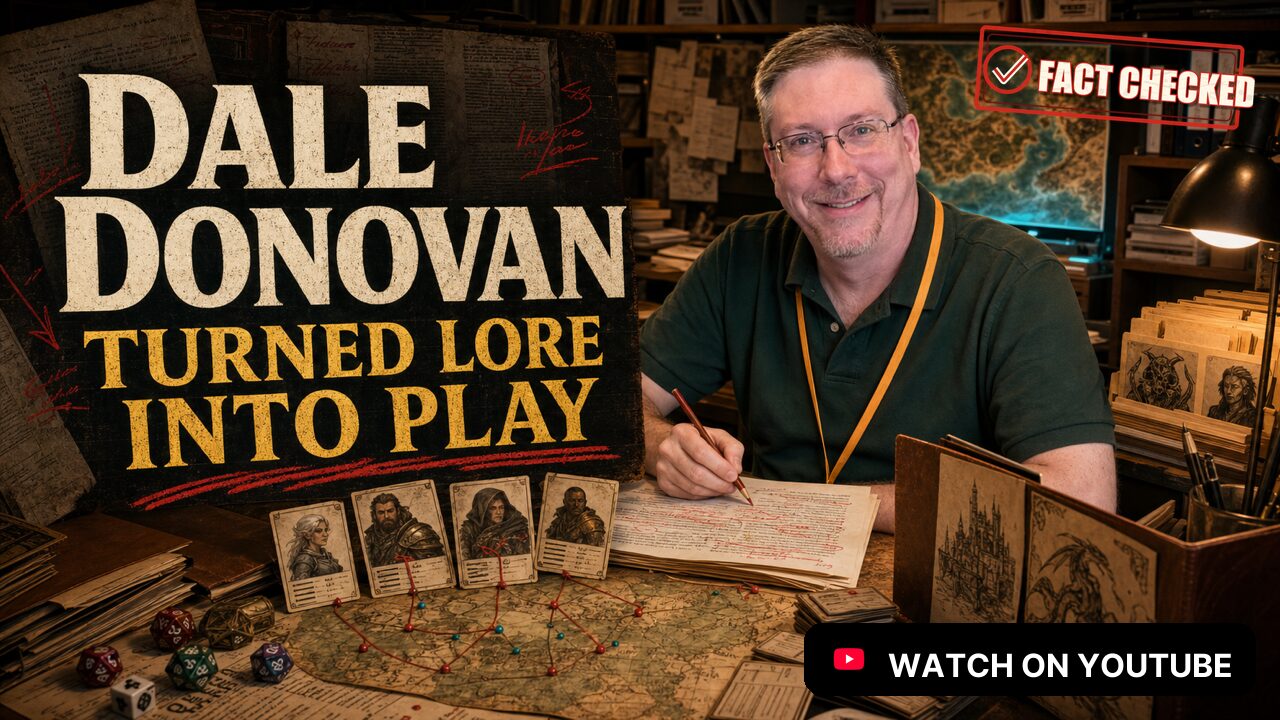
Dale Donovan turned lore into play. That is quiet work. It is also the work the table notices when it is gone.