
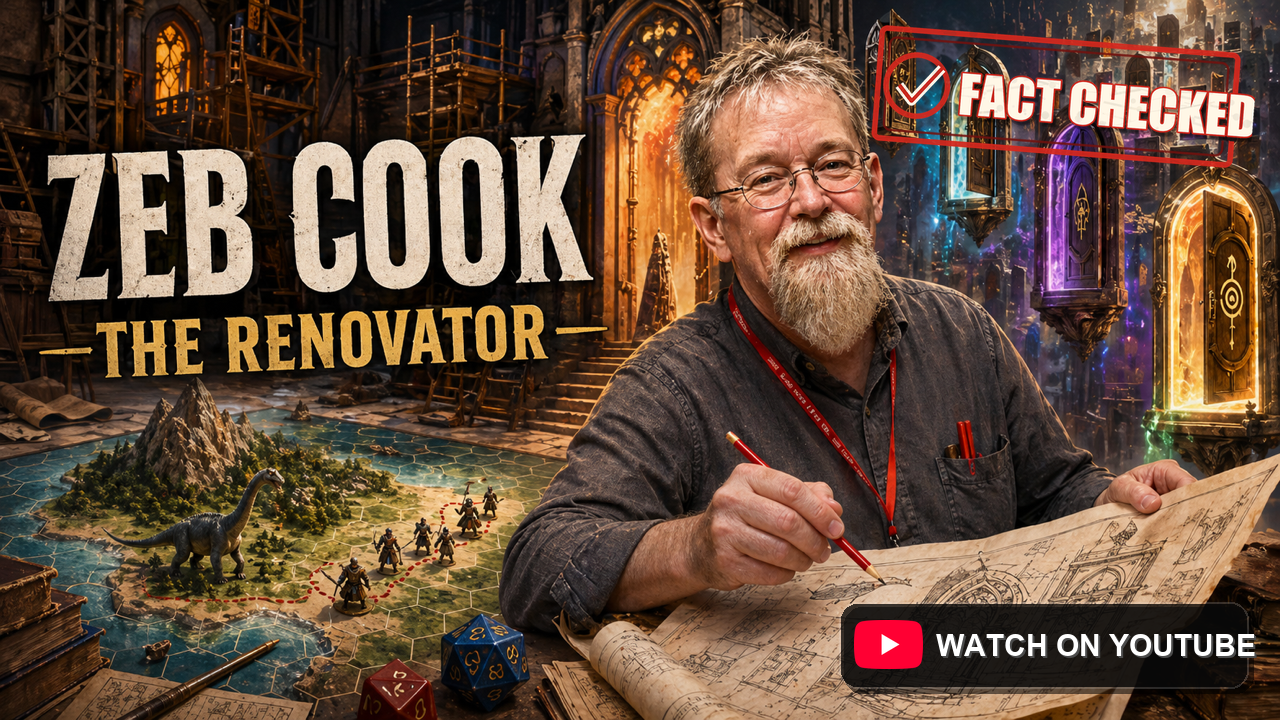
David Zeb Cook
Designer and editor
Adapted from the fact-checked Tabletop Game Icons profile and human-reviewed for Legends of TSR.
David \"Zeb\" Cook did not build the cathedral.
He renovated it while people were still praying inside.
That is a strange kind of responsibility. You are not allowed to call the place yours. You are not allowed to change its purpose. You are not even allowed to close the doors for long. But you can see the cracks. You can see where the stairwell leads nowhere. You can see where the same rule is explained three different ways and half the congregation has quietly invented their own fourth way.
That is the shape of Cook's Dungeons and Dragons legacy. Gary Gygax and Dave Arneson created the original miracle. They gave the hobby its first great structure: classes, levels, dungeons, monsters, spell slots, treasure, campaigns, and the idea that a table of people could enter an imaginary world together.
But by the late 1980s, Advanced Dungeons and Dragons was not a clean building.
It was brilliant, beloved, and sprawling. Rules lived in odd places. Subsystems did not always speak the same language. Some procedures were inherited from older wargaming assumptions, some from tournament play, some from magazine rulings, some from years of accumulated compromise. The game worked because people loved it enough to make it work.
TSR needed someone to modernize the thing without making it unrecognizable.
That is a dangerous assignment.
Change too little, and the mess remains. Change too much, and the audience decides the game has been stolen from them. Cook's career sits inside that tension again and again: make the complicated usable, preserve the magic, and slip better structure into a game that did not always want to admit it needed repair.
That is why he matters.
He is one of the bridges from early Dungeons and Dragons to the forms of Dungeons and Dragons people recognize today.
The Teacher At Tsr
Cook came to TSR with a teacher's background and a writer's discipline.
You can feel that in the work. Some designers build rules like locks. Cook often wrote rules like directions. Here is how the thing works. Here is what you can do next. Here is the part you are allowed to make your own.
His early TSR output moved fast.
A1: Slave Pits of the Undercity showed tournament discipline: tight spaces, clear objectives, tactical pressure, and a module built to be run under constraints. X1: The Isle of Dread, written with Tom Moldvay, did something larger. It gave Expert-level D&D a wilderness island to explore, with a hex map, lairs, ruins, monsters, coastlines, and the instruction that the world beyond the dungeon could be a place of adventure.
That module mattered because it taught a different kind of play.
The dungeon was not the whole game.
The map could open.
The players could choose a direction.
For a generation of DMs, Isle of Dread was a first real taste of wilderness sandbox play. It came packaged with the Expert Set and reached a huge audience because of that. It did not need to explain sandbox theory. It simply put a dangerous island in front of the table and let the table move.
Teach by giving people something usable.
The X In B/X
Cook wrote the Expert Rulebook for the 1981 Basic/Expert line, while Tom Moldvay handled Basic.
That pairing became one of the clearest versions of D&D ever published. Moldvay gave new players the first steps. Cook extended the game outward: levels four through fourteen, wilderness exploration, domains, broader magic, deeper play, and the sense that a campaign could expand beyond the first dungeon.
The Old School Renaissance would later build heavily on that version of the game.
There is a reason.
B/X D&D is not the biggest D&D. It is not the most mechanically complete. It does not try to cover every corner case. What it does is communicate the core game with unusual clarity. The rules are light enough to move, sturdy enough to last, and open enough for referees to build around.
Cook's Expert Set is part of that architecture.
It does not feel like a manifesto. It feels like a teacher extending the lesson at exactly the moment the students are ready for more.
That is why it still works.
Oriental Adventures And The Test Run
Oriental Adventures, published in 1985, is a complicated book to discuss now.
Its cultural framing belongs to its time, and modern readers can see places where the older D&D approach to Asian-inspired material needs caution. But as a rules document inside the history of D&D, it is important because it became a test bed for ideas Cook would carry forward.
One of those ideas was nonweapon proficiencies.
Characters could formally know things outside combat and spellcasting. Etiquette. Riding. Calligraphy. Survival. Craft. Social and practical competencies that made characters feel more like people living in a world.
Skill systems already existed in other roleplaying games. Cook did not invent the idea of characters having noncombat skills.
What he did was help bring that logic into D&D.
That distinction matters. D&D often changes by absorption. It sees an idea from the wider field, pulls it into the class-and-level body, and then that idea becomes part of how millions of players understand the game.
Oriental Adventures helped begin that process for skills.
It also showed Cook's broader instinct: D&D should be able to support different cultural and genre assumptions through rules as well as setting text. Classes, proficiencies, weapons, honor, social expectations, and magic all needed to do some of the work.
That lesson would matter later.
The Constrained Masterwork
AD&D 2nd Edition was Cook's hardest renovation.
The assignment was full of contradictions. Update the game, but keep it compatible. Clarify the rules, but do not make older books useless. Remove or rename material that had become politically dangerous during the Satanic Panic. Improve the structure, but do not frighten the existing audience.
Cook and the development team wanted to go further than they were allowed.
That matters because 2E is sometimes judged as if it were a clean-sheet design. It was not. It was a renovation under management constraints.
Within those limits, Cook helped make the game more legible. Classes were grouped into families: warrior, wizard, priest, rogue. Nonweapon proficiencies became a core optional framework. Specialty priests made clerics feel less generic by tying divine magic to spheres and gods. THAC0 was standardized. The rules were reorganized. The language was cleaned up. The game became easier to teach, easier to expand, and easier to publish around.
The kit system is one of 2E's most interesting ideas.
A kit let a player take a base class and give it a more specific identity: a fighter could become a swashbuckler, a cavalier, a gladiator, or something tied to culture, role, or campaign. The implementation could become messy. Some kits were flavorful. Some were overpowered. Some barely rose above costume.
But the underlying idea was important.
D&D characters needed modular identity inside the class system.
That desire is visible in 2E's kits. Players wanted a fighter to be this fighter, not only a member of a broad class category.
Cook did not solve the problem forever. He made it visible. He made it playable. He made it something later designers could improve without pretending it had never existed.
The Limits Of Second Edition
Second Edition still had problems.
It kept multiple resolution systems. Combat, ability checks, thief skills, saving throws, proficiencies, and special cases did not all share one clean engine. Armor Class still descended. The math was not as unified as later D&D would become. The kit books expanded quickly and unevenly. A game line that began as a cleaner version of AD&D eventually became its own thicket of options.
Cook knew some of the problems.
The team was not given permission to fix all of them.
That is why 2E is best understood as transitional architecture. It did not create modern D&D by itself, but it made the movement toward modern D&D possible. It kept the cathedral open. It widened corridors. It installed signs. It removed some hazards and left others because the owners would not let the renovation go further.
And it worked.
For many players, 2E was D&D. It powered campaign settings, novels, boxed sets, computer RPGs, and years of table play. Baldur's Gate, Icewind Dale, and Planescape: Torment all grew out of the 2E ecosystem.
That is not a minor legacy.
The Philosopher'S City
Planescape is the moment Cook's voice becomes unmistakably his own.
The assignment could have produced a dry manual of planes. Instead, Cook built Sigil, the City of Doors: a place at the center of everywhere, full of portals, factions, gods, fiends, philosophers, hustlers, and contradictions.
The core idea is still one of the boldest in D&D:
Belief shapes reality.
Not belief as flavor. Not belief as character motivation. Belief as metaphysical force. The planes are not only locations. They are arguments. The factions are not only clubs. They are philosophies with street addresses, enemies, slang, habits, and consequences.
Planescape was a way of making ideas playable. The Athar, the Dustmen, the Harmonium, the Xaositects, the Sensates, the Bleak Cabal: each faction gave players a worldview to inhabit or fight against. Alignment stopped being only a moral label and became architecture.
Sigil itself felt different from any prior D&D city. It was urban, weird, dangerous, funny, cynical, literate, and strange. It had cant. It had attitude. It had the Lady of Pain, one of the most unforgettable presences in the game, made powerful partly because she refused explanation.
And it gave D&D tieflings in a form that later editions would expand and make mainstream.
Cook did not know tieflings would become a core D&D identity decades later. That is part of the charm. Sometimes a setting-specific idea escapes the setting because players recognize something useful in it.
Planescape did not become D&D's biggest commercial setting at the table.
It became one of its most influential imaginative spaces.
The Long Shadow
Planescape's afterlife may be larger than its original shelf.
Planescape: Torment took Cook's setting into video games and became widely regarded as one of the most memorable computer RPGs of its era. Its obsession with memory, identity, regret, philosophy, and consequences could not have existed in the same way without the world Cook helped define.
Then that lineage kept moving.
Disco Elysium is often discussed in the same breath as Planescape: Torment, and its creators have talked about the older game's shadow. That does not mean Cook designed Disco Elysium. It means the kind of roleplaying imagination Planescape helped make possible did not stop in the 1990s.
Some settings do not just entertain you. They teach you what kinds of stories games are allowed to hold.
Planescape taught a generation that the argument itself could be the adventure.
The Side Rooms
Cook's career was broader than D&D renovation.
He designed or worked on licensed games such as The Adventures of Indiana Jones and the Conan Role-Playing Game. He worked on Star Frontiers and other TSR lines. He tried different genres, including science fiction, pulp, espionage, westerns, board games, and party games.
Not all of it endured.
That is part of the honest assessment. Cook's strongest legacy is not that every original system he touched became a lasting engine. Some of those designs were competent and interesting without becoming foundational. His most important work happened when he was translating, revising, extending, and reimagining existing structures.
That is not a weakness.
It is the pattern.
Some designers build from nothing. Cook was often at his best when he had a complex structure in front of him and a mandate to make it playable.
What He Actually Built
David \"Zeb\" Cook built bridges.
He bridged dungeon play to wilderness play with the Expert Set and Isle of Dread. He bridged early D&D to skill-based character identity through Oriental Adventures and nonweapon proficiencies. He helped bridge Gygaxian AD&D to the cleaner, more modular language that later editions would develop. He bridged fantasy adventure to philosophical worldbuilding with Planescape.
He was not the original architect of D&D.
He was the renovator who made the building easier to inhabit.
That distinction matters, but it does not diminish him. The history of games is not only invention. It is also translation, repair, teaching, modernization, and the ability to preserve what people love while changing enough to let the game survive.
Cook's best work treats players with respect. It assumes they can learn. It assumes they will improvise. It assumes that if you give people a clear structure, they will fill it with their own stories.
That is a quiet kind of influence, and it lasts.
Where To Find Him
Start with the Expert Set if you want the clean teaching voice.
Read The Isle of Dread if you want to see wilderness adventure opened up for a generation of DMs. Read Oriental Adventures carefully, historically, and critically if you want to see an early D&D prototype of later skill logic. Read AD&D 2nd Edition if you want the great renovation under constraint.
Then read Planescape.
That is where the renovator becomes the philosopher. The doors open. The city bends around belief. The factions argue reality into shape.
If you want Cook in his own words, look for long-form interviews and convention guest bios. They tend to reveal the same throughline the books do: a teacher's instinct for clarity, and a refusal to break what players already love.
And somewhere in the background is Cook's real gift:
The complicated thing becomes playable.
The cathedral remains standing.
The doors still open.