
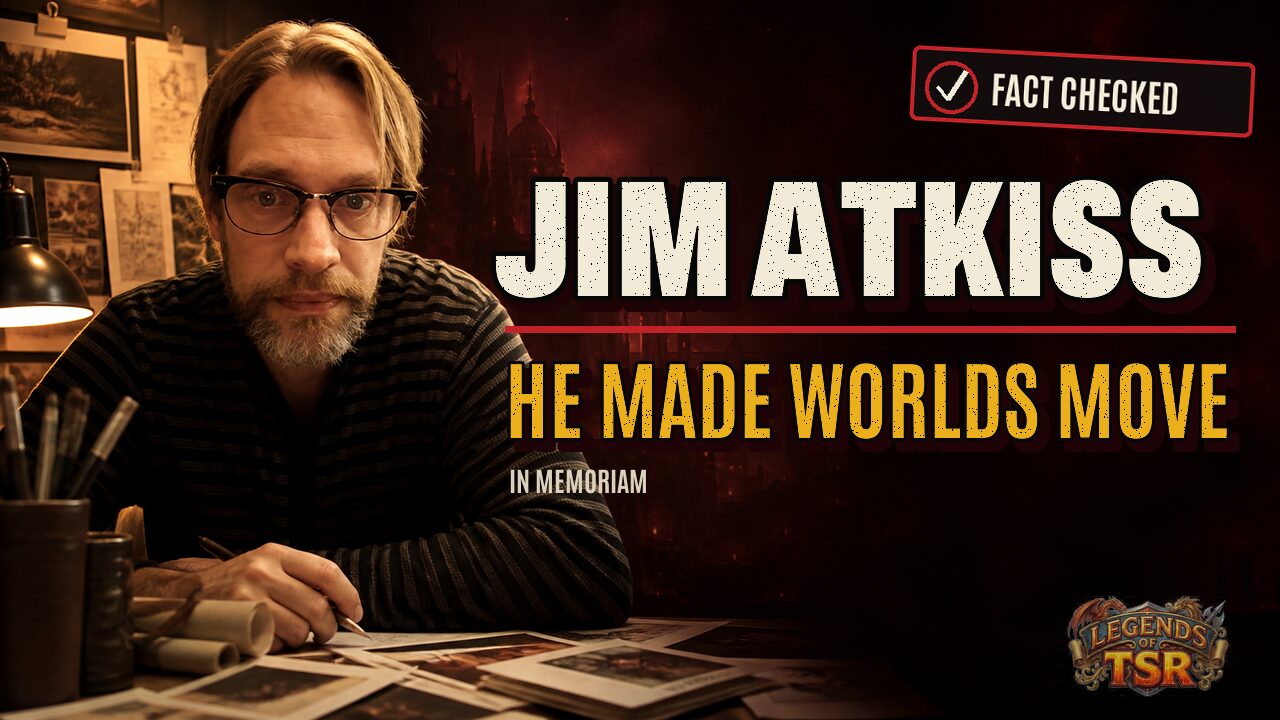
 In Memoriam
Jim Atkiss
U.S. advertising; later TSR marketing (sales involvement recalled by Ken Whitman)
TSR documented Jul 1990-Sep 1995; exact hire/departure dates unknown
A fact-checked memorial profile, researched and human-reviewed for Legends of TSR.
Most of the names remembered from TSR are printed on covers.
Jim Atkiss worked on the other side of the book.
He helped place the ads, carry the message, and connect the worlds TSR created with the people who might enter them. Later, he took that same skill through fantasy art, hobby-game sales, console publishing, and online games. His career crossed the point where tabletop culture became a much larger entertainment business.
That kind of work is easy to miss. A designer can point to a rule. An artist can point to an image. An editor can point to a page. Marketing is visible everywhere and credited almost nowhere.
Atkiss left a trail anyway.
THE NAME IN THE MASTHEAD
In July 1990, Dragon magazine listed Jim Atkiss under U.S. advertising.
The credit returned in August and September. It was a small line in the masthead, but it places him inside TSR during a crucial period. Advanced Dungeons & Dragons Second Edition was new. Forgotten Realms was expanding. Ravenloft, Spelljammer, and the fiction program were helping turn TSR from a publisher of games into a publisher of worlds.
All of that material had to reach an audience.
Advertising at TSR meant more than buying space. The company published magazines, novels, boxed sets, adventures, accessories, and games into a market that was becoming crowded and specialized. Every line needed a reason to exist. Every release needed an identity. Retailers needed to understand what belonged on the shelf, and players needed to recognize what belonged in their campaigns.
Ken Whitman remembers Atkiss working in Sales. The surviving documents use advertising and marketing. Those descriptions fit together without being identical. They place him in the commercial machinery that translated creative work into attention, orders, and long-term customers.
By October 1993, Dragon referred to him simply as “Jim Atkiss of TSR” in its Gen Con coverage. The phrase is brief, but it confirms that his connection to the company continued beyond those 1990 mastheads.
THE DESIGN CREDITS
Atkiss was not only standing outside the creative process.
His name appears among the designers of DLR3 Unsung Heroes, a 1992 Dragonlance accessory built around memorable nonplayer characters. It appears again in the 1995 Dark Sun Monstrous Compendium Appendix II, a book full of creatures designed for one of TSR's most distinctive settings.
Those credits do not turn him into a career game designer. They show something more useful about the way TSR worked.
The walls between departments were real, but they were not absolute. People in editing, art, sales, marketing, production, and administration could contribute ideas to products. A company built around imagined worlds naturally pulled some of its employees toward the page.
Atkiss's credits suggest a staff member who understood both the product and the audience. He knew what TSR was trying to sell because, at least occasionally, he helped make it.
THE MOVE TO FPG
In September 1995, Steve Jackson Games reported that Jim Atkiss, “recently of TSR's marketing department,” had become Vice President of Marketing for FPG.
That sentence gives his TSR story a clear endpoint and a clear next chapter.
FPG—Friedlander Publishing Group—was known for collectible trading cards built around fantasy, science-fiction, and comic art. The move made sense. Atkiss was leaving one company that packaged imaginative worlds for a dedicated audience and joining another that turned fantasy imagery into collectible products.
The medium changed. The central problem did not.
How do you take something fans care about and present it in a form they will notice, understand, and want?
At FPG, Atkiss moved into executive marketing. In 1996, he was elected a vice president of the Game Manufacturers Association. That role placed him in the wider business conversation at a moment when the hobby industry was being reshaped by collectible games, mass-market licensing, and new relationships between publishers, distributors, and retailers.
TSR was struggling with those changes. Atkiss was moving through them.
FROM TABLES TO SCREENS
The next phase of his career followed games into the digital market.
Later professional records and credits connect Atkiss to companies including Wizards of the Coast, Namco Hometek, and Sony Online Entertainment. MobyGames credits him on 23 games released between 2000 and 2007, primarily in marketing and brand roles.
At Namco, he worked in product marketing during an era of major console releases. At Sony Online Entertainment, he was credited as Brand Manager on Legends of Norrath, the online strategy-card game tied to the EverQuest universe.
That title brings his career into a neat circle.
At TSR, he helped market physical worlds through magazines, products, stores, and conventions. At Sony, he helped manage a digital game connected to an online world. The tools had changed completely. The job still depended on understanding a community and giving that community a reason to pay attention.
Atkiss's path mirrors the path of the industry itself. Tabletop publishing led to collectible products. Hobby sales grew into broader game marketing. Boxed games gave way to console launches and persistent online brands.
He did not spend his career attached to one famous title. He spent it moving with the business around the titles.
THE WORK BEHIND THE WORK
Marketing can become invisible when it succeeds.
The player sees the cover, the advertisement, the convention display, the store shelf, the press release, or the launch. The labor connecting those pieces disappears into the product's arrival.
That invisibility has shaped the historical memory of companies like TSR. Fans remember the writers, artists, designers, and executives. They remember the games that reached them. They do not always remember the people whose job was to make sure those games could be found.
Atkiss belongs in the story because TSR was not only a creative studio. It was a publishing and sales organization trying to move an extraordinary volume of material through a volatile market. The people in advertising and marketing were part of the structure that made the creative work public.
His later career strengthens that point. He carried the same professional specialty into several different corners of the game business. Companies changed. Formats changed. Audiences changed. The need to connect a product with its public remained.
THE SECOND CAREER
Atkiss eventually stepped away from game-company marketing.
His professional profile connects the later part of his life to Starbucks in Ontario, where a memorial account says he worked for more than nine years. It was a different industry and a more local kind of customer relationship, but it also provides the final bridge confirming his identity across the surviving records.
Jim Atkiss died on March 8, 2022.
Don Daglow's Games Industry Memorial remembered him through the companies that marked his career: Wizards of the Coast, Sony, Bandai Namco, 2K, and Sierra. That list captures the scale of his journey. It began in the masthead of a tabletop magazine and crossed some of the largest changes the game business experienced.
WHAT HE ACTUALLY BUILT
Jim Atkiss built attention.
That may sound less romantic than building a world, drawing a dragon, or writing a rulebook. It is not less necessary.
Creative work has to cross a distance before it matters. It has to move from the person who made it to the person who might love it. Advertising, marketing, sales, brand work, conventions, retailers, and press all help carry it across.
At TSR, Atkiss was part of that crossing. His product credits show that he could contribute inside the worlds as well. His later career shows that the skill traveled.
He moved from Dragon mastheads to fantasy collectibles, from hobby-industry leadership to console marketing, and from tabletop worlds to online ones. The credits are scattered because the work was scattered. Put together, they describe a professional who spent years helping imagined worlds find real audiences.
WHERE TO FIND HIM
You can find Jim Atkiss in the U.S. advertising lines of Dragon issues 159, 160, and 161. You can find him in Dragonlance and Dark Sun credits. You can find the moment he left TSR in a 1995 industry notice, and the rest of his career in the marketing credits of games released under Namco and Sony.
Most of all, you can find him in a part of game history that deserves more attention: the work between making something and getting it into another person's hands.
Jim Atkiss helped carry the worlds.