
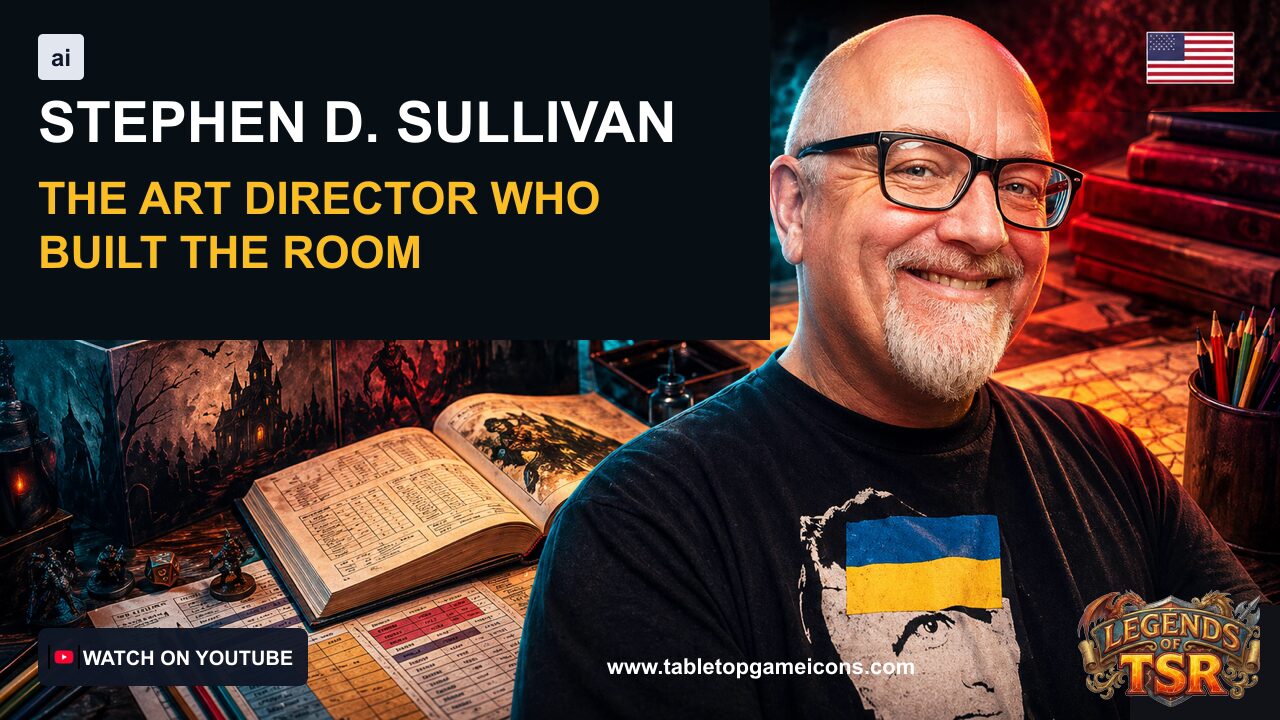
Stephen D. Sullivan
Art direction, graphics, illustration, cartography, and editing
Stephen D. Sullivan's documented production career shows how art direction, graphics, illustration, cartography, and editing help make game material usable without becoming uncredited mechanical authorship.
RESEARCHED PROFILE — SOURCE REVIEWED
Status Key
VERIFIED FACT: Supported by a direct product credit or first-party record.
SUPPORTED FACT: Supported by Stephen D. Sullivan's official first-person credits, but not independently confirmed by an original product credit in this review.
EDITORIAL INTERPRETATION: Analysis drawn from the documented work. It is not a historical credit.
UNCERTAIN / DISPUTED: Current evidence is inadequate, conflicting, or missing. The claim is not presented as fact.
AI DISCLOSURE: AI assisted with drafting and editorial review. Every historical claim in this profile was checked against the locked sources listed below. AI output is not treated as a source.
Rules do not arrive at a game table as ideas. They arrive as pages, charts, maps, screens, illustrations, boxes, and books. Someone has to decide how those objects will speak before a player reads the first sentence.
EDITORIAL INTERPRETATION
Stephen D. Sullivan's tabletop career is best understood in that physical layer. His documented record crosses art direction, graphics, illustration, cartography, editing, and design-team participation. Those roles are different from sole authorship or mechanical design, and this profile keeps that boundary visible. Together, though, they describe a person who repeatedly worked on the objects through which games become usable.
The Credit Lines
SUPPORTED FACT
Sullivan's official credits page describes work at TSR that moved between editorial and visual production. He identifies himself as editor of Ghost Tower of Inverness, editor of Top Secret: Rapidstrike, and part of the editorial team and art work on B3 Palace of the Silver Princess. These are Sullivan's own role descriptions. They support a cross-functional production history, but they do not turn editing into authorship or art into game design.
That distinction is the foundation of this profile. A credit should say what the person did, not what an admirer wishes the credit meant.
EDITORIAL INTERPRETATION
The pattern in Sullivan's work is not hidden authorship. It is proximity. Editors, artists, cartographers, and graphic designers work close to the moment when a manuscript becomes an object other people can use. Their choices can clarify, confuse, invite, warn, or establish a genre before the rules are tested in play. That influence is real, but it must not be used to claim uncredited mechanics.
The Pacesetter Role
SUPPORTED FACT
On his official credits page, Sullivan describes his Chill work as art direction, design-team participation, and graphics. He also says that he worked on every Pacesetter product. No original credit page for every item in the line was recovered for this source review, so the statement remains attributed to Sullivan rather than converted into a blanket independent fact.
The wording matters. Art director, design team, and graphics are substantial production roles. They are not proof that Sullivan designed every system, wrote every rule, or originated every concept. The surviving evidence supports a person working across a small company's visual and editorial machinery. It does not support a single creator standing above the rest of the team.
EDITORIAL INTERPRETATION
In a compact publisher, those jobs can overlap in practice even while the credits remain distinct. An art director may see manuscripts, charts, illustrations, and product plans in the same production cycle. A graphics worker may have to understand the information well enough to present it. Design-team participation may place that person in discussions about the whole object. The record lets us describe that working environment. It does not let us assign Sullivan a mechanic that no source gives him.
The Action Table Boundary
UNCERTAIN / DISPUTED
No locked source credits Sullivan with designing the Pacesetter Action Table, its mathematics, its probability model, or its rules system. No locked source ties him specifically to the table's layout, columns, labels, placement on a screen, or usability. Earlier language that called him its primary architect exceeded the evidence and is retired from this profile.
SUPPORTED FACT
The record does support Sullivan's own description of art direction, graphics, and design-team work on Chill. A separate product credit page for the Chill Master's Screen / Castle Dracula accessory credits him with cartography and illustration on that specific item.
EDITORIAL INTERPRETATION
Art direction and graphics can shape how game information is presented. That is a general reading of Sullivan's documented production work, not a claim that he created or laid out the Action Table. The difference is not cosmetic. One sentence honors the evidence; the other invents a credit.
Wabbit Wampage
VERIFIED FACT
The printed credits for the 1985 board game Wabbit Wampage give the roles precisely. Mark D. Acres receives game design credit. Andria Hayday receives writing credit. Stephen D. Sullivan receives cover and illustration credit. Hayday and Sullivan share the graphic design credit.
Those four lines control the attribution in this profile.
SUPPORTED FACT
Sullivan's official page adds his own description of editorial and design-team participation, art direction, and cover art on the game. Where that wording goes beyond the printed role lines, it remains a first-person self-credit and is identified as such.
UNCERTAIN / DISPUTED
The current source lock does not establish that Sullivan originated the Wabbit Wampage concept, developed its rules, or determined its mechanical identity. This profile does not assign him those roles.
EDITORIAL INTERPRETATION
What the direct record does establish is still meaningful. Cover illustration helps announce a game's tone before the box is opened. Graphic design helps organize the physical encounter with the game. In Wabbit Wampage, Sullivan's contribution belongs to that visual and graphic identity, alongside Hayday's joint graphic-design credit and without taking Acres's game-design credit away from him.
Chill and Black Morn Manor
SUPPORTED FACT
Sullivan's official credits page identifies him as art director, design-team participant, and graphics contributor on Chill. The same page lists art direction and graphics for Black Morn Manor. No original Black Morn Manor credit page was recovered for this review, so this profile does not expand those roles into design, writing, or mechanical authorship.
VERIFIED FACT
The credit page for the Chill Master's Screen / Castle Dracula accessory names Sullivan for cartography and illustration. The evidence is accessory-specific. It does not establish a rules-system or Action Table credit for Chill as a whole.
EDITORIAL INTERPRETATION
Taken together, those records show a maker working across several parts of production. The work was not simply decoration added after design ended. Cartography, illustration, graphics, editing, and art direction are part of how a game product takes form. They affect what readers encounter, what they notice first, and how the publisher presents a consistent world. That is an interpretation of documented roles, not a replacement credit.
What He Actually Built
Stephen D. Sullivan was not the credited game designer of Wabbit Wampage. The printed credit belongs to Mark D. Acres. Sullivan was not proven by this source review to be the creator of the Pacesetter Action Table. He is not presented here as the mechanical designer of Chill or Black Morn Manor.
Those corrections do not reduce his record. They make it legible.
SUPPORTED FACT
The source-locked record gives Sullivan editorial work on Ghost Tower of Inverness and Top Secret: Rapidstrike, editorial-team and art work on B3 Palace of the Silver Princess, art direction and graphics on Black Morn Manor, art direction, design-team participation, and graphics on Chill, cartography and illustration on a specific Chill accessory, and cover, illustration, and joint graphic design on Wabbit Wampage.
EDITORIAL INTERPRETATION
That is a career built across the seams of tabletop publishing. Sullivan's importance is not that every object around him was secretly his design. It is that his credited work repeatedly sat where story, rules, images, maps, and physical presentation met.
The clean version of the thesis is narrower than the old one and stronger because of it.
EDITORIAL INTERPRETATION
Stephen D. Sullivan built the room.
Where to Find Him
VERIFIED FACT
Stephen D. Sullivan maintains an official author site with a first-person biography and a detailed credits page. The site showed current first-person activity through July 30, 2026 when reviewed on August 25, 2026. His biography says he moved to Wisconsin in 1980 and has remained there. That supports a United States residence display, not a claim about citizenship or nationality.
The official site is the clearest public place to read Sullivan's own account of his work. This profile uses that account where appropriate, then keeps original printed credits in control when a product record is more precise.
Profile Metadata
Country display: United States, residence only; citizenship and nationality not established.
Living-person status: Supported as of 2026-08-25 by current first-person official-site activity.
Research status: Source reviewed 2026-08-25.
Updated: 2026-08-25.
AI Disclosure
AI assisted with drafting, comparison, and editorial quality checks. The final text was reviewed claim by claim against the source lock. Interpretations are labeled, unresolved credit claims are not promoted to facts, and no AI-generated statement is used as evidence.
References
1. Stephen D. Sullivan, “Credits: Books, Comics, Games,” official author site. Accessed 2026-08-25. https://stephendsullivan.com/about/credits-books-comics-games/
2. Wabbit Wampage, Pacesetter no. 6002, 1985, printed credits page in a scan of the original product. Accessed 2026-08-25. https://files.spawningpool.net/docs/Vault2.0.-.Card-board-and-miniature-games/Board%20games/Wabbit%20Wampage/Pacesetter%206002%20-%20Wabbit%20Wampage%20Board%20Game%20%5B1985%5D.pdf
3. Chill Master's Screen / Castle Dracula, product credit page. Accessed 2026-08-25. https://www.scribd.com/document/759886928/Pacesetter-2004-Chill-1st-Ed-Chill-Master-s-Screen
4. Stephen D. Sullivan, “About Me,” official author site. Accessed 2026-08-25. https://stephendsullivan.com/about/
5. Stephen D. Sullivan, official home page. Accessed 2026-08-25. https://stephendsullivan.com/