
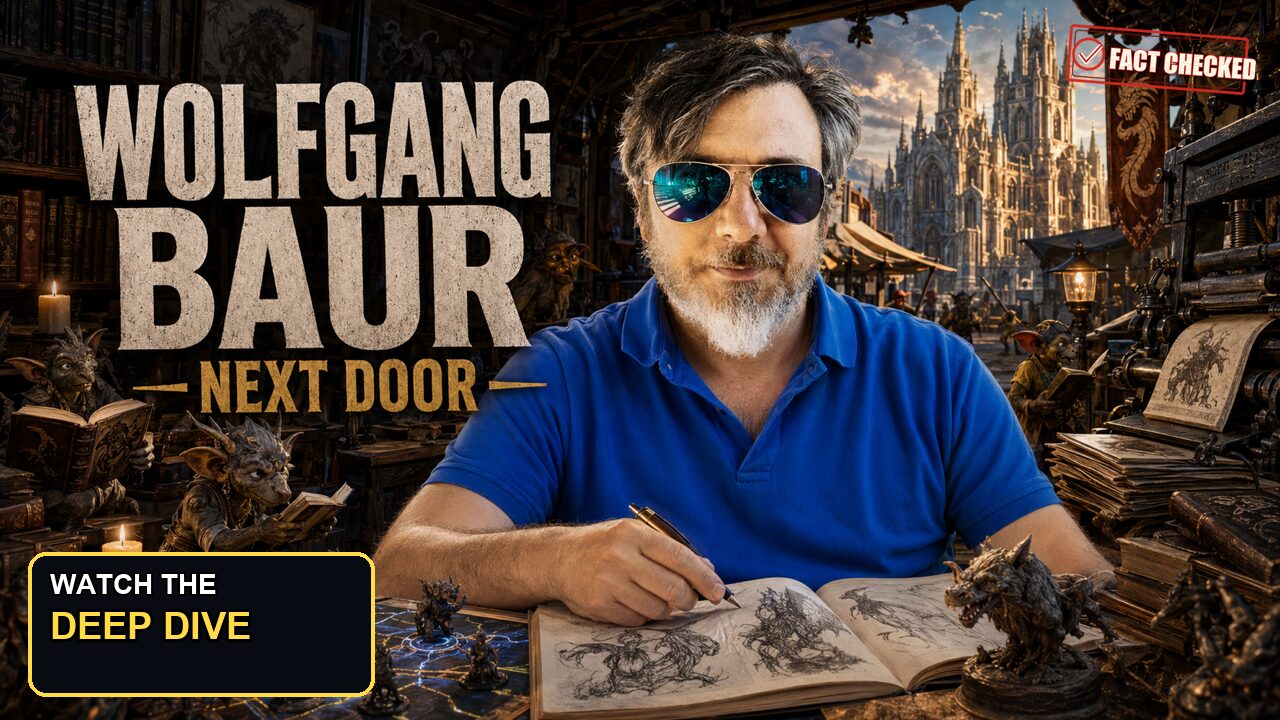
Wolfgang Baur
Magazine editor
Adapted from the fact-checked Tabletop Game Icons profile and human-reviewed for Legends of TSR.
Wolfgang Baur did not build Dungeons & Dragons.
He built beside it.
That is the key to understanding his career. Baur's best work lives in the space just outside the main cathedral: the side streets, the strange bazaars, the shadow roads, the workshops where monsters are still being carved after the official doors close for the night.
He is not famous because he invented a new roleplaying engine that replaced D&D. He is famous because he learned how to make professional-grade work inside D&D's orbit without waiting for D&D's owners to give him permission.
Adventure design. Magazine work. Dark fairy-tale worldbuilding. Patron-funded publishing. Monster books. Designer essays. A company that could stand close enough to the cathedral to serve its audience and far enough away to keep its own voice.
That was the build.
Not a new cathedral.
A neighborhood.
The Tsr Education
Baur came into professional gaming through TSR, but not as a tourist.
He had been submitting to Dungeon magazine young. He had a science background, a writer's appetite for structure, and the specific kind of patience adventure design requires. A good adventure is not a plot summary. It is a machine for play: rooms, factions, clues, pacing, pressure, secrets, maps, rewards, and enough open space for players to ruin the author's plan in interesting ways.
At TSR, Baur worked in the last great flowering of AD&D 2nd Edition settings.
Al-Qadim. Planescape. Birthright. Dark Matter. Dungeon and Dragon magazine. The era was messy, underfunded in places, overextended in others, and creatively alive in ways corporate publishing often becomes only when nobody is looking too closely.
That was an education.
Baur learned how official D&D products were built. He learned what a line needed from an adventure, how setting material supported play, how editorial development shaped raw writing, and how strange ideas could survive if they were useful at the table.
He also learned the other lesson.
Corporate publishing is not designed around the needs of one designer's imagination.
It has schedules. Licenses. budgets. Strategy shifts. Brand concerns. Product lines that vanish. Editors who save work and executives who cancel it anyway. TSR's collapse in the 1990s was not an abstract business case to the people inside it. It was a lesson in how fragile the official house could be.
Baur took that lesson with him.
The Adventure Voice
Before Kobold Press became the obvious thing to talk about, Baur had already built a serious reputation as an adventure designer.
Assassin Mountain took Al-Qadim's fantasy of holy slayers, secret fortresses, desert politics, and murder mystery structure and made it playable. Planes of Chaos helped turn Planescape's impossible metaphysics into places characters could actually visit. Kingdom of the Ghouls, published in Dungeon magazine, became one of those adventures people kept naming long after the magazine issue should have disappeared into storage boxes.
That matters.
Baur's strongest early work did not depend on mechanical novelty. It depended on situation.
A ghoul kingdom under the earth. A mountain fortress where faith, politics, and assassination share the same corridors. Planar environments where philosophy has teeth. These are pressure systems. The locations have motives. The monsters have institutions. The factions want things before the player characters arrive.
That is the difference between an encounter and an adventure.
An encounter asks what happens in this room.
An adventure asks what happens if this place is real enough to push back.
Baur understood that early.
Story First, Stats Later
One of Baur's most durable instincts is that rules should serve the story shape of the adventure.
That does not mean rules do not matter. He has written plenty of crunchy D&D material: monsters, spells, environmental hazards, planar effects, feats, prestige-class-era machinery, 5E-compatible stat blocks, and entire books of mechanical options.
But his best work rarely begins with the stat block.
It begins with mood, premise, culture, and consequence. A ghoul empire needs hunger and hierarchy before it needs armor class. A shadow fey court needs etiquette, threat, bargains, titles, and impossible beauty before it needs initiative counts. A Midgard ley line needs to feel like a force in the world before it becomes a bonus at the table.
That design priority gives Baur's work a recognizable flavor.
Dark fairy tales. Central European and Slavic textures. Court politics. Monsters with laws. Places where folklore and feudalism sit beside practical adventure hooks. A willingness to be grim without becoming dull.
He is very good at making D&D feel older, stranger, and less domesticated.
The Patronage Move
In 2006, Baur made the move that may be his most original contribution to the hobby.
He launched Open Design.
The idea was simple and radical for professional RPG publishing at the time: patrons would fund a project before publication, follow or influence parts of the design process, and receive the finished work. Baur framed it in terms of patronage rather than conventional retail. The audience did not merely buy the thing after it existed. The audience helped make the thing possible.
This was before Kickstarter turned crowdfunding into a standard tabletop path.
That timing matters.
Open Design proved that a small RPG publisher could use community funding to create professional material outside a corporate line. It also created a different relationship between designer and audience. Patrons could see drafts. They could argue about choices. They could feel the work becoming real.
The Diana Jones Award recognized Open Design in 2008.
That was not a prize for a combat mechanic. It was recognition of a publishing structure. Baur had found a way to make professional RPG design happen around the old gatekeepers.
Again, the pattern holds.
He built next door.
Kobold Press
Open Design eventually became Kobold Press, and Kobold Press became one of the most important third-party RPG publishers of the 5E era.
That sentence is easy to write now because the company exists. It was not guaranteed.
Third-party D&D publishing has always lived with a strange dependency. You can make work for the world's largest roleplaying game, but you do not own that game. You can serve its audience, but you do not control the rules license. You can build a brand, but the gravitational pull of D&D remains enormous.
Baur made that tension productive.
Kobold Press became a house style: usable adventures, dark fantasy settings, monster books with bite, design essays, and enough polish to sit beside official material without pretending to be official material.
That last distinction is important.
Kobold Press did not become powerful by rejecting D&D. It became powerful by understanding the parts of D&D's ecosystem that official publishing could not fully satisfy. Dungeon Masters always need more monsters. They need more spells. They need more places. They need adventures with sharper teeth, stranger courts, deeper folklore, and fresh threats after the official Monster Manual becomes familiar.
Baur built a company around that need.
Midgard
Midgard is the setting where Baur's voice is most concentrated.
It is not generic fantasy with a different map. It is dark, courtly, folkloric, and full of moving roads. Ley lines matter. Shadow roads matter. Gods wear masks. Ravenfolk, gearforged, ghouls, dragons, dwarves, and fey courts all occupy political space, not only monster entries.
The setting's endurance is one of its strongest arguments.
Midgard has moved across multiple rules systems and editions. That tells you something. A setting that only works because one rules engine props it up is fragile. Midgard keeps surviving translation because its strongest elements are not tied to a single stat block.
The ley lines are a good example.
As a mechanic, they give magic spatial weight. Power is not only on the character sheet. It runs through the world. A caster's relationship to place matters. That is a very Baur idea: make the setting do mechanical work.
The masked pantheon is another.
Gods can appear differently across cultures. Religious identity becomes layered instead of flattened. That lets the setting hold mythic ambiguity without needing every culture to share the same simple list of divine names.
These are smart ideas.
They did not become industry-wide mechanics. They did not found a new school of RPG design.
They did exactly what they needed to do.
They made Midgard feel like Midgard.
The Monster Books
For many 5E players, Kobold Press means Tome of Beasts.
That is fair.
The Tome of Beasts line gave Dungeon Masters hundreds of new monsters at a moment when 5E tables were hungry for options. It was not merely quantity. The books offered a different bestiary voice: weirder creatures, folklore creatures, courtly fey, brutal undead, strange dragons, clockwork horrors, and monsters with enough story hooks to suggest scenes rather than only fights.
Monster books are easy to underrate as design.
They should not be.
A good monster is a small adventure seed. It needs role, mood, tactical behavior, ecological suggestion, and a reason to exist. It has to be legible to the DM and surprising to the players. It has to fit into a system's math while still feeling alive at the table.
Kobold Press did not hit that mark perfectly every time. Third-party 5E monster design has always had balance debates, and Tome of Beasts has had its share.
But the line mattered because it became part of real table practice.
It gave DMs something official books could not provide fast enough: surprise.
The 5E Moment
When Wizards of the Coast launched 5E, Kobold Press helped write the first published adventure path for the edition: Hoard of the Dragon Queen and The Rise of Tiamat, known together as Tyranny of Dragons.
That was an institutional endorsement.
It showed that Baur's company was not only a third-party shop working around D&D. It had become trusted enough to help with the official launch ecosystem.
The adventures themselves have been debated by players for years. Early 5E adventure design was still discovering what the edition wanted to be. But the assignment remains significant. Kobold Press had moved from next door to the cathedral's front steps.
Later, the relationship became stranger and more modern.
Kobold Press material appeared on D&D Beyond, including Tome of Beasts. The old line between official and third-party became more porous. A company built outside the walls was now visible inside one of D&D's central digital marketplaces.
That is part of Baur's legacy too.
Not because it proves he invented D&D.
Because it proves that professional work built outside the original institution could become necessary to the broader ecosystem.
Tales Of The Valiant
The OGL crisis gave Kobold Press another test.
When trust in the old license structure cracked, Kobold Press announced the project that became Tales of the Valiant. The premise was clear: keep a familiar 5E-style fantasy engine available under a more stable open framework, and give publishers and players another place to stand.
Tales of the Valiant is not a clean-sheet invention.
It is a refinement and continuation of the 5E style. That matters for design credit. The foundation still owes a great deal to D&D. But as a publishing act, it fits Baur's whole career. When the cathedral's rules became uncertain, he helped build a working hall next door.
Again, not replacement.
Infrastructure.
The man keeps doing the same thing at larger scales.
What He Actually Built
Wolfgang Baur built professional independence inside D&D's shadow.
He did not invent the d20 system. He did not invent 5E. He did not create the fantasy adventure. He did not build the cathedral.
He built a place where strong work could happen beside it.
As a designer, his strengths are adventure architecture, dark worldbuilding, folklore-inflected fantasy, and settings that make monsters political. As a publisher, his contribution is larger: Open Design, Kobold Quarterly, Kobold Press, Midgard, Tome of Beasts, the Kobold Guides, and a working model for serious third-party RPG publishing.
That distinction matters.
If you score only mechanics, Baur is not the person who changed the basic language of roleplaying games.
If you score the lived structure of the hobby, he becomes much harder to ignore. He helped show designers that they could build outside the official line, fund work directly, publish professionally, teach craft, and serve the D&D audience without being owned by D&D.
That is not a small thing.
Where To Find Him
Start with Kingdom of the Ghouls if you want the adventure designer.
Look at Assassin Mountain and Planes of Chaos if you want the TSR-era craftsman working inside rich settings. Read Midgard if you want the worldbuilder. Read Tome of Beasts if you want the publisher who understood what Dungeon Masters needed after the official monsters became familiar.
Then look at Kobold Press itself.
That may be the real text.
The company is the argument Baur has been making for nearly two decades: RPG design does not have to wait for permission from the largest house in the neighborhood. It can be funded, written, edited, illustrated, published, taught, and played next door.
The cathedral is still there.
Baur made the street outside it livelier.